Equinox / FsCodec sample
The source sample implements IStateStore with Equinox and FsCodec. It uses Equinox's gRPC EventStoreDB backend, tested against KurrentDB 26.1.1.3690. The sample targets .NET 10 and keeps backend dependencies outside Ranvier's core and persistence packages.
What each library does
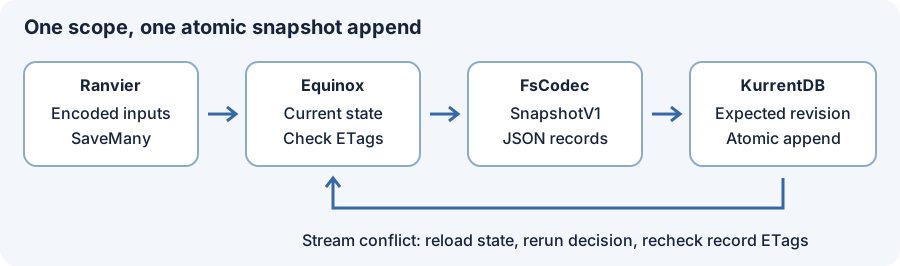
- Ranvier encodes persisted inputs with the application's codecs and restores them into a graph.
- Equinox loads the current scope, runs a decision and commits at the expected stream revision. A competing append reloads state and reruns that decision.
- FsCodec maps the versioned
SnapshotV1event to an event type and JSON body. - KurrentDB durably stores the event stream. Equinox can use other backends with different category wiring; this sample tests the EventStoreDB backend.
The decision validates every supplied record ETag again after a retry. A stale record fails instead of overwriting the winning value. Unconditional writes merge into the freshly loaded scope.
Run the round trip
Start a disposable server with the KurrentDB installation guide. Set the connection, then run the sample:
$env:RANVIER_EQUINOX_CONNECTION = "esdb://localhost:2113?tls=false"
dotnet run --project samples/Ranvier.Persistence.Equinox -c Release -- customer-42
The connection uses esdb:// because Equinox.EventStoreDb depends on EventStore.Client.Grpc.Streams. The local insecure connection above should be replaced with the server's TLS and authentication settings for production.
Expected output:
Restored count=21; doubled=42
The executable creates a persisted signal, sets it to 21 and awaits FlushAsync. It then loads the stored inputs into a fresh graph, where a memo recomputes 42. Graph work runs synchronously; the queued save continues after graph disposal and is awaited before reloading.
Use it in an application
Reference samples/Ranvier.Persistence.Equinox/Ranvier.Persistence.Equinox.fsproj, or copy StateStore.fs with its package references. This is a source sample rather than a published adapter package.
open EventStore.Client
open Ranvier.Persistence
open Ranvier.Samples.EquinoxFsCodec

use client = new EventStoreClient(EventStoreClientSettings.Create connectionString)
let store = EquinoxStateStore(client, "customer-42") :> IStateStore
With a project reference, Ranvier.Samples.EquinoxFsCodec.Program.roundTrip store returns a task completing with (21, 42). Copying only StateStore.fs provides the store implementation.
Keep the caller-owned client for the application's lifetime. The sample uses an uncached Equinox Decider and the current Serilog logger. Use a stable scope to reload the same inputs.
See Persisted inputs for keys, codecs, migrations and busters.
Conditional writes
Ordinary PersistSession writes currently carry ETag = None, which permits an unconditional insert or replacement. Preserve a loaded record's ETag for an explicit conditional write:
let incrementStored () =
    task {
        let! records = store.LoadMany [ "count" ]
        let current = records.Head
        do! store.SaveMany [ { current with Payload = string (int current.Payload + 1) } ]
        return! store.LoadMany [ "count" ]
    }
Run the round trip first to seed "count". If another writer changes or deletes that record, EquinoxStateConflictException.Key identifies the rejected key. Task-to-async bridges may wrap the exception in AggregateException. Reload and resolve the conflict in the application.
A successful save changes the saved records' ETags; unrelated records retain theirs. StoredRecord.Version remains the payload codec version. Reload to get new tokens.
Scope, capacity and history
- Each scope has one stream: category
ranvierEquinoxV1, followed by a base64url UTF-8 scope identifier. Scopes are case-sensitive, valid Unicode strings of at most 512 UTF-8 bytes. - Every mutation writes the complete scope in a
SnapshotV1event, limited to 1 MiB of encoded JSON. This suits small persisted state. The server may impose a lower limit. - One
SaveManycommits all its records atomically. Duplicate keys, malformed tags and invalid Unicode are rejected. - Equinox permits at most 32 append attempts under stream contention. Exhausted retries and connection errors propagate. A connection failure can leave acknowledgement uncertain; reload before retrying a conditional write.
- Delete and clear remove current records by appending a snapshot. Historical events remain. These operations are logical deletion.
- Reserve these streams for the sample. Unknown or corrupt latest events fail reads and writes. Physical deletion, truncation and age-based expiry can invalidate state. Manage retention explicitly and retain at least the latest snapshot.
Adapt the event contract and Equinox access strategy to an application's storage needs. Journal transports remain separate work under #185.
Integration tests
Set RANVIER_EQUINOX_CONNECTION to a disposable server:
dotnet test tests/Ranvier.Persistence.Equinox.Tests -c Release
The suite covers shared storage/ETag contracts, independent clients, atomic rollback, concurrent distinct-key writes, repeated snapshots, readable FsCodec events, corrupt heads, capacity limits and graph restart. A missing or unavailable server fails the run. CI tests both trace variants and runs the executable.