Replay a production shop bug
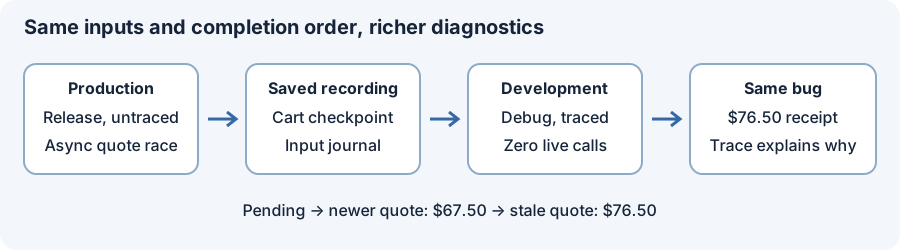
An older shipping response arrives after the shopper changes their cart. It replaces the newer quote, raising the total from $67.50 to $76.50. Capture the incident in an untraced Release build, then reproduce it in a traced Debug build with zero live service calls.
The runnable example lives in Ranvier.Examples. Its walkthrough covers the saved files, async gateway and verification checks.
Run the incident
Install the .NET 10 SDK. Check out the example revision and its pinned Ranvier source:
git clone https://github.com/shayanhabibi/Ranvier.Examples.git
cd Ranvier.Examples
git checkout 1e26a146650c0b9b05805b5e6a9d2d564cc01e61
git submodule update --init --recursive
Choose a capture directory that does not exist, then run the two builds:
dotnet run --project src/Ranvier.Examples.ShopReplay -c Release -p:RanvierTrace=false -- capture tmp/shop-incident
dotnet run --project src/Ranvier.Examples.ShopReplay -c Debug -p:RanvierTrace=true -- replay tmp/shop-incident
The shop prices tea at $25, applies SAVE10, checks stock and offers free shipping above $50. Two requests overlap:
- One tea starts a shipping request. The source is pending.
- The shopper changes to three teas while that request is still pending.
- The newer quote returns free shipping: $75 minus $7.50 is $67.50.
- The older quote returns $9 shipping. The buggy gateway accepts it, producing $76.50.
The gateway reads local shipping rules asynchronously and uses completion gates to arrange this order reliably. This is an application race demonstrated in a production build; both builds run the same shop code.
What makes replay deterministic
Three APIs cooperate:
- Persistence saves the cart and the checkpoint's journal position.
- The input journal records cart edits, async results or failures, and flush boundaries.
- Tracing explains the computations in the development replay.
The checkpoint precedes both requests. Restoring it creates the same pending source. Replaying the cart edits reconstructs the request sequence, and the journal supplies the recorded outcomes in their original order. The gateway captures Journal.work before checking Journal.replaying, then skips external calls in diagnostic mode. Persist.replay ReplayMode.Diagnostic applies the recorded tail after the checkpoint.
Pending and returned values are enough for this incident when the triggering edits and completion order also match. Replay preserves the observable sequence, rather than waiting for the original network delays. Applications that depend on a clock or randomness must expose and record those inputs too.
Read the cause
Both processes print the same five checkout observations, from the restored pending cart through the two completions. Replay checks each observation against the production capture and writes:
replay-why.txt: the receipt's last run traced back to the stale shipping result.replay-snapshot.txt: the labelled pricing and checkout graph.replay-trace.jsonl: the development trace.
The explanation ends at the older quote's settlement:
why /receipt run 5
  ... Mark /receipt <- /checkout
  ... Mark /checkout <- /shipping
  ... Settle /shipping = { Revision = 1; Shipping = 900; Stock = 8 }
The defect is the unconditional acceptance of a response for an earlier cart revision. Keep that deliberate defect while following the example; correcting it should make the recorded incident assertion fail.
Try a failure and verify repeatability
dotnet run --project src/Ranvier.Examples.ShopReplay -c Release -p:RanvierTrace=false -- capture-failure tmp/shop-failure
dotnet run --project src/Ranvier.Examples.ShopReplay -c Debug -p:RanvierTrace=true -- replay tmp/shop-failure
python tools/verify-shop-replay.py
The failure scenario reproduces an older request failing after the newer quote succeeds. The verifier launches three fresh replay processes and checks their traces byte for byte, as well as failure replay, checkpoint immutability and rejection of damaged recordings or incompatible codecs.
The sample copies an acknowledged, quiescent checkpoint before async work starts. It keeps stable input keys, compatible codecs and matching graph construction. Read the restore limits before adapting it to checkpoints containing in-flight work or distributed storage.